Review: English Touring Opera – The Wild Man of the West Indies

Tags

, ,

The Birmingham Post isn’t always able to post online everything that I’ve written for its print edition, so – after a suitable time lag (you should really go out and buy the paper!) – I’ll be posting my recent reviews here. As per the print edition, they’re all fairly concise – just 250 words. This is of a performance at Warwick Arts Centre on 23rd April 2015.


1 Wild Man
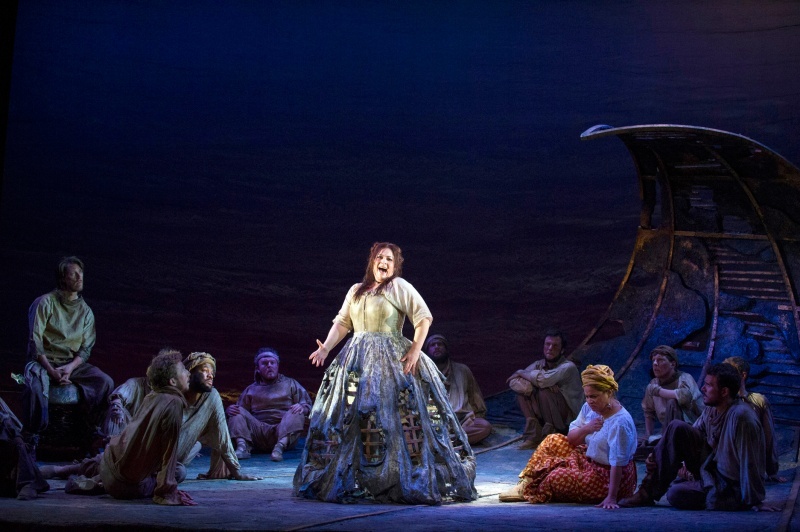
Donizetti’s 1833 opera Il furioso all’isola di San Domingo is a real rarity. The Cervantes-derived story – of a nobleman unhinged by heartbreak, on the loose in the Spanish Caribbean – sounds bizarre, and sure enough, this is one of those operas whose plot summary reads like an absolute car-crash. In fact, as Iqbal Khan’s new production for English Touring Opera demonstrates, it makes perfect dramatic sense when imaginatively staged – and packs a real emotional punch as it does so.

It’s an opera semiseria: a misleadingly unwieldy term for a drama that interleaves comedy and pathos rather more powerfully (to this ear) than some of Donizetti’s outright tragedies. And it could hardly be better-served than by Khan’s production. Florence de Maré’s semi-abstract set suggests the stormy seas that drive the plot, while Mark Howland’s lighting poetically evokes both the colours of the Caribbean evening and the characters’ emotional state.

At the heart of it all was Craig Smith, as the “Wild Man” Cardenio himself: Smith’s warm vocal tone and sympathetic characterisation (little vocal tics suggested his mental affliction) made him a figure of wounded dignity. Sally Silver as his penitent wife Eleonora and Nicholas Sharratt as his brother Fernando delivered swashbuckling high notes and moments of poignant sorrow; Silver, in particular, made convincing emotional sense of the redemptive final scenes.

Peter Brathwaite played the slave Kaidamà as light relief, somewhere between Ariel and Leporello; Njabulo Madlala and Donna Bateman made their roles as sympathetic as slave-drivers can be. The orchestra under Jeremy Silver rose to the vocal characterisation on stage with some wonderfully stylish playing: string portamenti and vibrato-free passages brought out all the fantasy and colour of this entertaining and touching operatic rediscovery.


Review: BCMG Songbook

Tags

, ,

The Birmingham Post isn’t always able to post online everything that I’ve written for its print edition, so – after a suitable time lag (you should really go out and buy the paper!) – I’ll be posting my recent reviews here. As per the print edition, they’re all fairly concise – just 250 words. This is of a performance at CBSO Centre, Birmingham on 27th February 2015.


There were champagne glasses out at CBSO Centre on Friday night: and rightly. This was the first Birmingham outing for Gerald Barry’s new setting of Tennyson’s Crossing the Bar – the 75th commission, since 1991, in BCMG’s Sound Investment scheme.

Other than that, this was a very BCMG kind of celebration: no frills, just a thought-provoking and beautifully-curated programme played straight and to the highest imaginable standard. The programme was built around the songs that John Woolrich has commissioned from over 200 composers since the late 80s. Each was scored for soprano (Gillian Keith and Rebecca von Lipinski took turns), plus solo strings and two clarinets. Conductor Jonathan Berman provided such guidance as was necessary.

The format made for illuminating contrasts. Certain mannerisms recurred – icy harmonics, juddering sul ponticello tremolandi – but more striking was the way the small form intensified each composer’s individuality. The wiry tangle of Milton Babbitt’s Quatrains sat between the Barry – a typically deadpan bit of Barry provocation, the text chanted in an aggressive monotone by Lipinski, and then sung over clangourous piano chords – and a delicious nonsense scherzo by the late Jonathan Harvey, playfully and affectionately thrown off by Keith.

Thomas Adès’ fidgety, overwritten early Life Story hasn’t worn well; Osvaldo Golijov’s Sarajevo, on the other hand, sounded just as rich and strange as it must have done in 1993. Lipinkski’s warmly responsive singing conjured up the ghost of Mahler in (of all writers) a Flann O’Brien setting by Kurt Schwertsik; Berg haunted Keith’s performance of Detlev Glanert’s Contemplated by a Portrait of a Divine.

But the fragility and poise of Gillian Keith’s voice in three Celan songs by Harrison Birtwistle gave the evening its centre of gravity. Birtwistle’s measured phrases and resonant silences connected with the poetry on what felt like a subconscious level. Again: no frills, just loving, perfectly-judged performances of music that has eloquence to spare.

Review: Hong Kong Phiharmonic / van Zweden

Tags

, , ,

The Birmingham Post isn’t always able to post online everything that I’ve written for its print edition, so – after a suitable time lag (you should really go out and buy the paper!) – I’ll be posting my recent reviews here. As per the print edition, they’re all fairly concise – just 250 words. This is of a performance at Symphony Hall, Birmingham on 3rd March 2015.


A single Chinese character forms the title of Fung Lam’s 40th-anniversary showpiece for the Hong Kong Philharmonic Orchestra. In English, three paragraphs of programme notes merely leave the impression that its English name, Quintessence, doesn’t quite cover it. What the piece actually does, via a series of brief, memorable ideas – flashing violin runs, percussion and harp tracery, deep Sibelian brass chords – is provide a mini-concerto for orchestra that leaves absolutely no doubt about the HK Phil’s collective virtuosity.

And yet, Lam doesn’t really draw on this orchestra’s greatest strengths. The opening bars of Dvorak’s 9th Symphony laid those out unmistakably: a rich, focussed and gloriously warm-sounding string section, phrasing and moving together, plus as characterful and expressive a woodwind and horn team as you could hope to find anywhere in Bohemia.

Conductor Jaap van Zweden shaped a brisk but intensely lyrical performance – with long, singing lines that gave a really epic sense of sweep, notwithstanding van Zweden’s tendency to micromanage phrase endings and tempo changes. The whispered string phrases that underscored Kwan Sheung-fung’s plangent cor anglais solo in the Largo were wonderfully expressive and tender.

The sheer beauty of the orchestral sound was also the most enjoyable aspect of Beethoven’s Violin Concerto, with Ning Feng as soloist. The spin has promised great things about Feng’s playing; more significantly, so has the orchestral grapevine. He has stage presence, and – when he doesn’t force it – a powerful, shining tone. But in this of all concertos, a little more nuance really wouldn’t have gone amiss. This was a reading that sported oh-so-stylishly in the shallows.


Review: Ava’s Wedding – a new opera by Michael Wolters

Tags

, ,

The Birmingham Post isn’t always able to post online everything that I’ve written for its print edition, so – after a suitable time lag (you should really go out and buy the paper!) – I’ll be posting my recent reviews here. As per the print edition, they’re all fairly concise – just 250 words. This is of a performance at the Crescent Theatre, Birmingham on 26th February 2015.


1 Ava

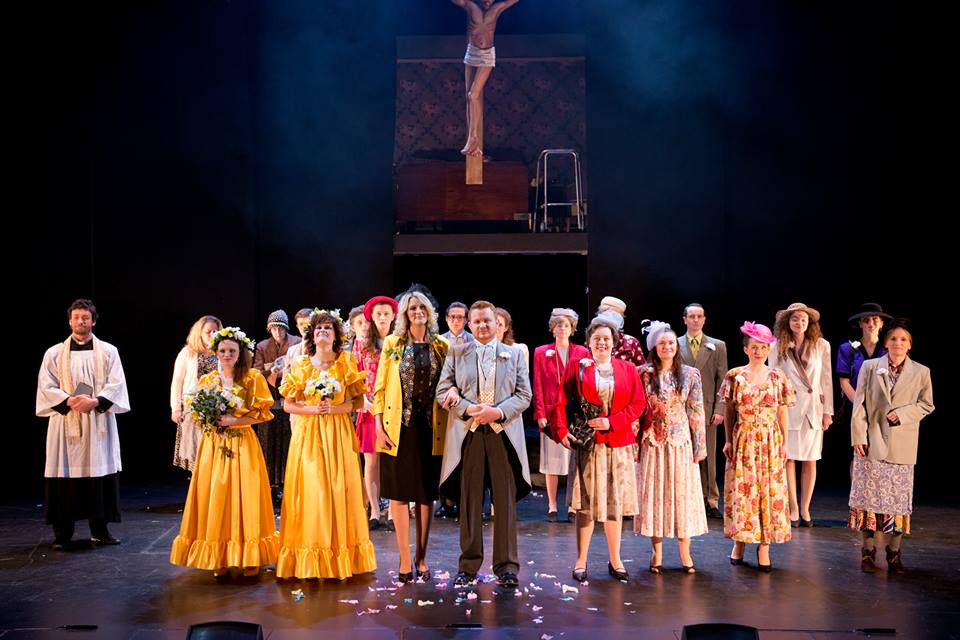
Ava’s Wedding, a new opera by Michael Wolters and librettist Alexandra Taylor, was written specifically for Birmingham Conservatoire. Whatever else it might be, that’s a significant achievement, as was this whole vividly-realised premiere production.

There are caveats. Ignore the patronising programme essays: the idea of using grand opera conventions to satirise English manners is as old as Gilbert and Sullivan. Taylor’s expertly-crafted libretto is one of the least poetic we’ve heard in a modern opera – and that’s high praise. But a few details jarred: did the word “Islamophobia” even exist in 1988, the period evoked by Colin Judges’ designs and Jennet and Alan Marshall’s costumes? The inner logic of a comic opera has to be watertight.

Because that’s what this is: a pacy black comedy of an extended family hurtling towards a series of disasters that they’re all simply too polite to avoid. Director Michael Barry handled the interlocking storylines deftly and lucidly. Eleanor Hodkinson played Ava with quiet desperation; the punk Holly (Victoria Adams) and her rival Georgia (Elizabeth Adams) nearly brought the house down with a pair of matched coloratura arias about bridesmaid’s dresses, while estranged sisters Patricia (Samantha Oxborough) and Rita (Eloise Waterhouse) each found real pathos in their balancing accounts of a family feud.

But with 21 named parts, a five-part chorus representing Truth, and at least 10 separate storylines it was hard for individual characters to emerge; and the grand guignol ending left you unsure whether you were really meant to believe in any of them. Likewise, Wolters’ gutsy post-minimalist score: based on English composers from Ethel Smyth to Andrew Lloyd Webber, it often seemed to work against the emotion.

Under Fraser Goulding’s baton, though, it was never less than entertaining, and at moments – such as an exquisite four-part madrigal – seemed to be straining towards a real operatic tragedy, not just a parody. Frustrations notwithstanding, Ava’s Wedding leaves you wanting to watch it all over again: a rare feat for a new opera.

Review: Chandos Orchestra’s “Resurrection” Symphony

Tags

, , ,

The Birmingham Post isn’t always able to post online everything that I’ve written for its print edition, so – after a suitable time lag (you should really go out and buy the paper!) – I’ll be posting my recent reviews here. As per the print edition, they’re all fairly concise – just 250 words. This is of a performance at Tewkesbury Abbey on 21 March 2015.


You don’t have to be very old to remember when Mahler was still considered a cult composer. Yet here was a capacity audience in rural Gloucestershire, braving the bone-numbing chill of Tewkesbury Abbey to hear a superbly-prepared performance of the Resurrection symphony by an amateur orchestra and chorus based in Malvern.

From the powerful tone of the mens’ voices to the beautifully produced programme book, everything about this performance by the Chandos Symphony Orchestra and Chorale, under their music director Michael Lloyd, spoke of confidence. The opening was electrifying, and the big climaxes – superbly paced by Lloyd – delivered the necessary roof-raising thrills. He even kept a tight grip on the offstage brass: no mean feat in the Abbey acoustic, although the low temperature may have had an unavoidable effect on their intonation.

That acoustic was both the performance’s greatest ally and its worst enemy. There was a real spaciousness to the outer movements; the pounding, dissonant climax of the first has never sounded so much like Bruckner. But (from the seats at the rear of the Abbey, anyway) the woodwinds were generally inaudible within the orchestral texture, and the chorus’s first entry – that spine-tingling “Aufersteh’n” – was, presumably of necessity, far from Mahler’s whispered pianississimo.

But at its finest – like when mezzo Wendy Dawn Thompson’s Urlicht floated out into that great resonant space, and Kelly McCusker’s solo violin twined around it, or in the soul-shaking, organ-thundering final bars – this Resurrection hit home exactly as Maher must have hoped. A noble achievement.

Review: Royal Opera – The Rise and Fall of the City of Mahagonny

Tags

, ,

The Birmingham Post isn’t always able to post online everything that I’ve written for its print edition, so – after a suitable time lag (you should really go out and buy the paper!) – I’ll be posting my recent reviews here. As per the print edition, they’re all fairly concise – just 250 words. This is of a live relay at the Red Carpet Cinema, Barton-under-Needwood on 1 April 2015.


Between them, Birmingham Opera Company, WNO and English Touring Opera typically stage about a dozen live productions in the West Midlands each year. If you’re at all enthusiastic about opera, that’s woefully insufficient – which is why live cinema relays are worth taking seriously. The sound is more realistic than any home stereo, production values are high and the best cinemas in the region are as comfortably-appointed as any conventional theatre.

That was certainly the case at the Red Carpet Cinema at Barton Marina, where we saw the Royal Opera House’s current production of Brecht and Weill’s Rise and Fall of the City of Mahagonny. As with most filmed opera, the cameras tended to focus on individual singers rather than the whole stage picture, and the orchestral sound seemed ever so slightly recessed (much as you’d hear on a studio recording).

But other than that, John Fulljames’ punchy new production, with Es Devlin’s container-based sets and deadpan, brilliantly effective video projections by Finn Ross, was allowed to make its considerable impact. A luxury cast exuberantly hammed up Brecht’s cartoonish characters. Anne Sofie von Otter channelled a mix of Cruella de Vil and Mary Portas as Begbick, while Kurt Streit gave lowlife messiah Jimmy McIntyre the full heldentenor treatment.

If the nature of the piece – and perhaps Mark Wigglesworth’s raw, urgent conducting, too – perhaps encouraged some cast members to belt it out slightly too aggressively (Willard White, as Trinity Moses, was unusually gruff), that wasn’t necessarily to the drama’s disadvantage. But it didn’t stop a radiant-voiced Christine Rice – as the prostitute Jenny – simply walking away with very scene in which she appeared. It’s not every day you witness a cinema audience humming the Alabama Song

Review: Hagley Festival – The Ballad of St Kenelm

Tags

, ,

The Birmingham Post isn’t always able to post online everything that I’ve written for its print edition, so – after a suitable time lag (you should really go out and buy the paper!) – I’ll be posting my recent reviews here. As per the print edition, they’re all fairly concise – just 250 words. This is of a performance at the Hagley Music Festival on 22nd April 2015.


1 Hagley

The corner of the Midlands around Hagley has produced a disproportionate amount of words and music: think of William Shenstone, Francis Brett Young, and more recently Simon Holt’s opera Who Put Bella in the Wych Elm? Now the list is joined by Andrew Downes’ The Ballad of St Kenelm, commissioned by the Francis Brett Young society and premiered by members of the Central England Ensemble and community members as part of the 2015 Hagley Music Festival.

It’s a sort of musical mystery-play, in the spirit of Britten’s Church Parables. The poem is by Brett Young, retelling a legend of the Clent Hills, and while it’s worn better than you might expect (though there was one line which, while maybe acceptable in 1944, jarred badly today), it probably works better as a libretto than as literature in its own right.

Downes divided the verse between a narrator (the wonderfully sonorous Haydn Thomas), a small group of amateur actors (Oscar Price deserves special mention as the seven year-old King Kenelm) and a soprano. His daughter Paula sang that role tonight, bringing purity and an affectingly plangent tone to Downes’s lyrical, plainsong-like vocal writing. Conductor Cynthia Downes drew out the colours of the attractively pastoral score; the small orchestra clearly enjoyed Downes’s splashes of polytonality and the imaginative instrumental detailing in the work’s central lament.

The ending might, perhaps, have been broader, but Downes’s sincerity can’t be questioned. This was music deeply rooted in its community, and it’s a source of great sadness that ill health prevented Downes from attending. Hopefully he’ll be able to hear repeat performances at the Bewdley and Winchcombe festivals, with the same highly committed performers.

Review: English Touring Opera – The Siege of Calais

Tags

, , ,

The Birmingham Post isn’t always able to post online everything that I’ve written for its print edition, so – after a suitable time lag (you should really go out and buy the paper!) – I’ll be posting my recent reviews here. As per the print edition, they’re all fairly concise – just 250 words. This is of a performance at Wolverhampton Grand Theatre on 14th April 2015.


2 Siege

English Touring Opera has form with Donizetti, and it was director James Conway’s production of Anna Bolena that first convinced this born Wagnerite of Donizetti’s power as a musical dramatist. So we had high hopes for Conway’s adaptation of The Siege of Calais.

A defensive programme essay from Conway triggered some doubts. Act 3 was omitted outright and its material largely redistributed elsewhere. Conway’s intention seems to have been to throw the focus onto the moments when Donizetti’s patchy, bel canto-by-the-yard score comes up to the level that the drama demands; moments in which Conway and his company clearly believed passionately.

Samal Blak’s set created a timeless atmosphere of war-torn desolation, and in that handful of inspired numbers – most notably the extended finale, when the six burghers of Calais volunteer to die for their fellow citizens – this production worked nobly on its own terms. Throughout the excellent cast, characterisation was naturalistic and affecting.

Craig Smith was a craggy, dignified Eustachio, while Paula Sides as Eleonora and Catherine Darby in the trouser-role of her husband Aurelio both stood out vocally. Their poignant Act 2 duet was a high point – as was the way Darby’s voice gleamed through the glorious sextet that preceded the burghers’ final march to their fate.

The orchestra, under Jeremy Silver, did wonderful things with Donizetti’s woodwind writing; in fact, the only real problem with this production (if you can accept Conway’s rewrites – this is hardly William Tell, after all) was Donizetti himself. It’s always refreshing to see a rarity done with such conviction, but it was hard not to wonder what ETO might have achieved in an opera that the director believed to be stageworthy as written.

Review: English Touring Opera – La Boheme

Tags

, ,

The Birmingham Post isn’t always able to post online everything that I’ve written for its print edition, so – after a suitable time lag (you should really go out and buy the paper!) – I’ll be posting my recent reviews here. As per the print edition, they’re all fairly concise – just 250 words. This is of a performance at Wolverhampton Grand Theatre on 13th April 2015.


1 Boheme
Could you love anyone who didn’t love La Bohème? Illica and Giacosa’s libretto sketches out the discomfort and poverty with deadpan precision. But once Puccini does his thing, who wouldn’t wish themselves in that freezing Parisian garret, losing their heart while the smoke of a thousand chimneys curls into the evening sky?

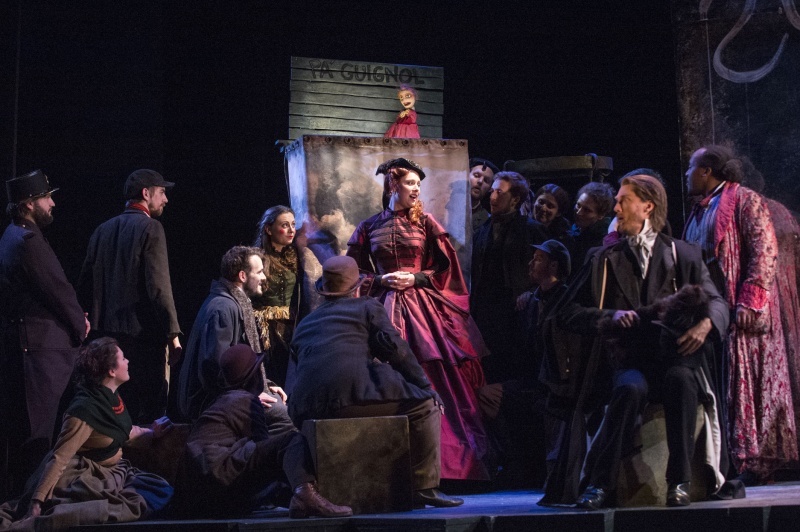
Yet Bohème is an opera that thrives on realism. And in James Conway’s new production for English Touring Opera, that’s what it gets, in a rough, bracing blast. There’s no watercolour sentimentality about Florence de Maré’s grungy, semi-abstract sets: a column of skulls stands macabre sentry over Act 4 and Act 1 is so dimly lit that the performers’ faces are sometimes barely visible.

But the strengths of this approach shone through in the interaction of the characters. There was a plausibly combative edge to the flatmates’ banter, and for all the sheen of his singing, David Butt Philip’s was a darker and more brusque Rodolfo than we’re used to seeing. Ilona Domnich matched him with a hesitant, nuanced Mimi; for once, you could spot the potential faultlines in their relationship.

They headed a cast in which there were no weak links; Grant Doyle was a likeably bluff Marcello, Sky Ingram an arresting Musetta with a vampish edge, and Njabulo Madlala and Matthew Stiff rounded out Schaunard and Colline engagingly. As always with ETO, lustrous singing came as standard, and under Michael Rosewell the orchestra made the score sound exuberantly fresh. Birmingham is fortunate to have opera of this quality so close at hand; if you haven’t yet made the short trip to see ETO, you’re missing something wonderful.

Throwback Thursday: The Berlin Philharmonic in Liverpool

Tags

, , , , ,

There’s one orchestra in the news this week – though let’s be honest, as we saw in  February, everything the Berlin Philharmonic do is newsworthy. Here’s the article that I wrote for Metro in 2008, when they played at the Liverpool Philharmonic Hall as part of the city’s year as European Capital of Culture. I was particularly chuffed to be able to talk to my old Birmingham colleague Jonathan Kelly for this article – not the first great musician to take the journey from Birmingham to Berlin, and not, I rather suspect, the last…


“I don’t want to sound arrogant” says Pamela Rosenberg.  “I think we’re considered to be the flagship orchestra in Germany and I know that our city, and chancellor Angela Merkel, see us as ambassadors.  But internationally, there are a lot of wonderful orchestras – and we’re in the mix”.

Fair enough.  Until, that is, you realise that Rosenberg is General Manager of the Berlin Philharmonic – and suddenly it becomes an understatement on an heroic scale.  For classical music fans, the BPO’s Liverpool gig is the unquestioned climax of 2008.  Tickets sold out months ago.  Because as anyone even remotely interested in classical music knows, the Berlin Philharmonic is arguably the finest orchestra in the world.

And best of all, it’s conducted by a Liverpudlian.  There’s not a music-lover on Merseyside who isn’t choked with pride to see Sir Simon Rattle coming home at the head of this legendary band.  But to appreciate the true significance of Rattle’s appointment as principal conductor in 2002, you need to understand the BPO’s unique place in German culture.  In the first half of the twentieth century, under its visionary conductor Wilhelm Furtwängler, it established itself as the supreme interpreter of the great German classics, from Bach through to Wagner.

Later, under the autocratic Herbert von Karajan, it developed a rich, silky-smooth sound that set a new international benchmark for orchestral playing.  “You may never again hear playing as beautiful as this” one critic is said to have told a younger colleague after a BPO concert “but now you know that it can be done”.

Berlin Phil oboist Jonathan Kelly feels the same way.  “I’ve been listening to CDs of this orchestra since I was a boy.  For me it’s always been an ideal”.  And seated bang in the centre of the orchestra, he’s uniquely placed to experience the Berlin sound.

“The sound is part of the orchestra’s tradition, something it’s very proud of” he explains.  “Everyone who joins the orchestra is aware of that, and maybe even adapts their own sound to fit.  What’s special about the sound is that it has this almost animal quality that rises up in concert, like a living thing.  It’s this wonderful dark sound, but also very strong.  This orchestra has incredible reserves of energy.  Everyone, from the front to the back, gives absolutely everything in a concert.  I love that.”

So what prompted the musicians to embrace a conductor as defiantly un-traditional as Rattle?  The BPO’s Liverpool programme – Messiaen’s orgasmic Turangalîla-Symphonie – could hardly be further from the orchestra’s ancestral heartland of Beethoven and Brahms.  Rosenberg sees Rattle’s appointment as proof of the musicians’ commitment to the future.

“I think it was a signal that the orchestra wanted to embrace innovation” she suggests. “Rattle’s broad-minded approach to music, and the huge scope of his interests, from early music to the 21st century – this was of great interest to the musicians.  Now, there’s a synergy – artistic exploration is fed by tradition, and that exploration refreshes the tradition.”  Kelly agrees:

“In some ways he’s found a meeting of two traditions.  Older players in the orchestra, especially the ones who played under Karajan, are very positive about him.  They like the fact that he’s so human.  He’s not a grand maestro type – he just wants to make music with them.”

And no orchestra makes music like the Berlin Phil.  At a time when Liverpool’s own rather fine Philharmonic is scaling new heights, the BPO is an inspiring example of how an orchestra can come to embody a modern city.  Rosenberg has a message for the European Capital of Culture:

“Classical music is vital for the communal health of a city.  It can be a galvanising instrument.  Both in Liverpool and in Berlin, orchestras have the potential to make a huge difference.  An orchestra contributes to both the social and the spiritual life of a city.  Without one, you’re looking at a wasteland”.