• Blog
  • Clients
  • About Me

Richard Bratby

~ Classical music writer, critic and consultant

Richard Bratby

Tag Archives: Birmingham Post

Review: English Touring Opera – The Siege of Calais

16 Saturday May 2015

Posted by richardbratby in Uncategorized

≈ Leave a comment

Tags

Birmingham Post, Donizetti, English Touring Opera, Reviews

The Birmingham Post isn’t always able to post online everything that I’ve written for its print edition, so – after a suitable time lag (you should really go out and buy the paper!) – I’ll be posting my recent reviews here. As per the print edition, they’re all fairly concise – just 250 words. This is of a performance at Wolverhampton Grand Theatre on 14th April 2015.


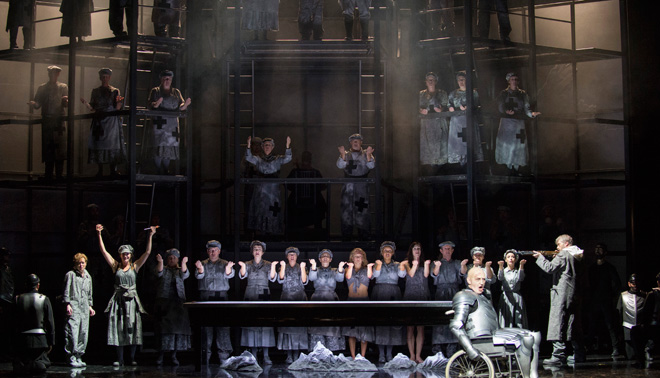
2 Siege

English Touring Opera has form with Donizetti, and it was director James Conway’s production of Anna Bolena that first convinced this born Wagnerite of Donizetti’s power as a musical dramatist. So we had high hopes for Conway’s adaptation of The Siege of Calais.

A defensive programme essay from Conway triggered some doubts. Act 3 was omitted outright and its material largely redistributed elsewhere. Conway’s intention seems to have been to throw the focus onto the moments when Donizetti’s patchy, bel canto-by-the-yard score comes up to the level that the drama demands; moments in which Conway and his company clearly believed passionately.

Samal Blak’s set created a timeless atmosphere of war-torn desolation, and in that handful of inspired numbers – most notably the extended finale, when the six burghers of Calais volunteer to die for their fellow citizens – this production worked nobly on its own terms. Throughout the excellent cast, characterisation was naturalistic and affecting.

Craig Smith was a craggy, dignified Eustachio, while Paula Sides as Eleonora and Catherine Darby in the trouser-role of her husband Aurelio both stood out vocally. Their poignant Act 2 duet was a high point – as was the way Darby’s voice gleamed through the glorious sextet that preceded the burghers’ final march to their fate.

The orchestra, under Jeremy Silver, did wonderful things with Donizetti’s woodwind writing; in fact, the only real problem with this production (if you can accept Conway’s rewrites – this is hardly William Tell, after all) was Donizetti himself. It’s always refreshing to see a rarity done with such conviction, but it was hard not to wonder what ETO might have achieved in an opera that the director believed to be stageworthy as written.

The Ice Break

24 Friday Apr 2015

Posted by richardbratby in Uncategorized

≈ 5 Comments

Tags

Birmingham Opera Company, Birmingham Post, Donizetti, English Touring Opera, Tippett

The best bit about my job is that I get to see – if not quite as much opera as I’d like – pretty well as much opera as is available to be seen in the West Midlands. This month’s reviews have ranged from a community opera in a Worcestershire country church to the Royal Opera House’s live cinematic relay of Brecht and Weill’s The Rise and Fall of the City of Mahagonny, as well as English Touring Opera’s annual spring triple bill.

Two of ETO’s offerings were Donizetti rarities – one (The Wild Man of the West Indies) a triumph, one (The Siege of Calais) a heroic failure – and while it’s always nice to have the chance to see unknown works done with such conviction and quality, the heart sinks slightly at the news that there’ll be more Donizetti next season. I’m not entirely sure the West Midlands needed two productions of Anna Bolena in one decade (let alone Maria Stuarda) – at least, not when that decade hasn’t seen a single professional production of Peter Grimes, Der Freischutz or Un Ballo in Maschera (to choose just three from a long list) in the region. On the other hand, if ETO’s forthcoming Pia de’ Tolomei is anything like as wonderful as their production of The Wild Man of the West Indies (aka Il Furioso all’isola di San Domingo), which I saw last night at Warwick Arts Centre, I’ll feel very churlish indeed for saying so.

Anyway, although The Birmingham Post is currently struggling to post reviews online, it did manage to get one if my recent reviews up within 48 hours of filing. And happily, it’s my review of what might just turn out to be the greatest thing I’ll see all year. Following on from last year’s tremendous ETO King Priam, the Tippett revival really seems to be gathering steam. And about time too

2014 appears to have vanished…

05 Monday Jan 2015

Posted by richardbratby in Uncategorized

≈ Leave a comment

Tags

Birmingham Post, Elgar, English Touring Opera, Henze, Lichfield Cathedral Chorus, Michael Seal, Royal Opera House, Sinfonia of Birmingham, Tippett, Welsh National Opera, Wolverhampton Grand Theatre

Everyone’s doing it so, a few days late, five selected musical highlights of 2014.


Welsh National Opera: Boulevard Solitude I know, I know…I’m supposed to go for WNO’s Moses und Aron, but I can’t help feeling that a really stupendous musical performance – plus an understandable missionary zeal amongst my colleagues – can’t quite make up for a production that basically avoided the issue. (Review here). Henze’s Boulevard Solitude, though…what a score! What a set of performances! And how they all came together to do exactly what this opera is surely supposed to do. (Review here).


English Touring Opera’s Spring Season ETO’s annual spring seasons at Wolverhampton Grand Theatre are a guilty pleasure for me – and a secret one, apparently: you’d think the music-lovers of Birmingham (population 1.1 million) would have worked out by now that with a 20 minute train-ride they could be seeing opera of this quality. Apparently not, judging from the empty seats for the Britten (though it can’t have helped that the Grand’s box office had mixed up the dates for Paul Bunyan and The Magic Flute – leading befuddled first-timers in the audience trying to work out why Papageno was strumming a guitar). They missed a Magic Flute that charmed and probed in equal measure, and, as I hoped, turned out to be the perfect choice of first live opera for my 12-year old godson  (“I didn’t know it would be like panto” he said when we saw it in Sheffield a month later). (Review here) A big-hearted, beautifully-designed Paul Bunyan (Mark Wilde as understatedly magnificent as always) that made the best possible case for – sorry – an absolute car-crash of a piece (Review here). And – thanks to the belated discovery that Cheltenham and back is do-able in a night from Birmingham – a shattering, monumental King Priam. (No review: there purely for pleasure) A tremendous achievement: god, Tippett is undervalued, isn’t he? Quite indecently excited now at the prospect of Birmingham Opera Company’s forthcoming The Ice Break.


Lichfield Cathedral Chorus: The Apostles Local choral societies don’t get national reviews. But I’ve been trying to persuade the Birmingham Post for some time that something a bit special is happening at Lichfield Cathedral (and not just because it’s 3 minutes from my front door). The cathedral’s musical team of Ben Lamb, Cathy Lamb and Martyn Rawles are young, gifted, and ambitious in the best possible way (the budget for the orchestra and soloists for this performance alone apparently cleaned out the Chorus’s coffers for the foreseeable future: respect due). And there’s no getting around the fact that Elgar’s choral writing taxed the Chorus beyond its limits. But the soloists were first-rate, the orchestra (Alex Laing’s DECO) was on fire and the sweep, musicality, and sense of shared adventure about the whole enterprise…well, it glowed in exactly the way it must have done in Elgar’s imagination. Grass-roots music making in the UK, and a living amateur tradition, continues to give us something as stirring – and as profoundly musical – as the most lavishly-funded international orchestra or opera house. (I submitted a review to the local paper but it never appeared in print. Two weeks later a review at three times the length by a writer I don’t know did appear, which I suppose is the main thing, but still…*rolls eyes*.)


Royal Opera House: Die Frau Ohne Schatten I adore Strauss and having missed the last UK production of FrOSch in the 90s, I realised that I couldn’t really risk waiting 20 years for another chance. Having shelled out for the necessary hotels and train tickets, and booked two days off work (in the absence of weekend matinees, the only way to do it from the Midlands) I can only say that boy, it was worth it. I can add nothing to the praise that’s already been heaped on this production: it echoed in my head for days afterwards. Yes, London receives an indefensible 15 times as much arts subsidy per head as the rest of the UK; an attempt to buy a drink in the Floral Hall left images of underfunded education projects, rejected funding grants and decades of shoe-string compromises in the regional arts swirling furiously in my mind. (“We don’t serve Prosecco” sniffed the barman – well, there’s one thing that the Royal Opera House has in common with Wolverhampton Grand Theatre, then.) But with singing like we experienced that night, you can at least hear where the £££s are going. File under “sinful pleasure”. Normal service will be resumed shortly.


Mihkel Poll in Sutton Coldfield It’s received wisdom that small local music clubs are dying out. Martyn Parfect, who runs the Sutton Coldfield Philharmonic Society, merely sees that as a provocation – he thinks big, and never bigger than when he’s twisting the arms of international soloists to play in Sutton’s Victorian linen-cupboard of a Town Hall. Pianistically, Pohl’s performance of Rachmaninov’s Third Concerto with local semi-pro band the Sinfonia of Birmingham was as fine as you’d expect. What lifted this to another level was watching and hearing the effect that an artist of his calibre had on the orchestral players – and the masterly (there’s no other word for it) way that the conductor, my colleague Michael Seal, coloured the music and shaped the concerto’s architecture in one huge, cumulative symphonic line. It’s always nice to be able to give a glowing review to artists you like and admire; in this case, no critical detachment was required. The performance set its own terms (Review here).
Countertenors and tubas at Lichfield Cathedral

16 Tuesday Dec 2014

Posted by richardbratby in Uncategorized

≈ Leave a comment

Tags

Birmingham Post, Handel, Lichfield, Lichfield Cathedral, Lichfield Cathedral Chorus, Messiah, Staffordshire Band

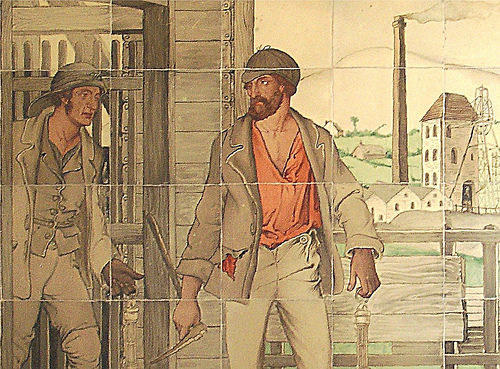
Selwyn tomb

This picture comes from the tomb of the 19th century Bishop Selwyn of Lichfield. It’s in the Lady Chapel at Lichfield Cathedral, and this tiled rendering of a pit on the nearby Staffordshire coalfield is the backdrop to a fabulous Victorian confection of stone Gothic tracery, brass lettering and a gleaming, life-sized marble effigy of the great Bishop himself. No-one saw anything odd about putting this image in a mock-Medieval tomb in a real Medieval cathedral. The scene – so recognisable to members of the Bishop’s flock – was part of the flesh and blood of his life and ministry; being truthful, it couldn’t be incongruous. (At the other end of the tomb, similar painted tiles show a Maori war-canoe and tree-ferns – Selwyn spent much of his career in New Zealand).

It came to mind because on Saturday night, Birmingham Post business (and to be honest, a fair bit of personal pleasure) took me to a performance of Part One of Handel’s Messiah by the Lichfield Cathedral Chorus, accompanied by the Staffordshire Brass Band. My review of the performance is here; but even before the night, I was surprised by the way musical friends reacted to the very notion of a brass band accompanying Handel. “Christ, no!” exclaimed one. “This is all wrong” declared another. At which I could only think: how could something wrong, sound so right?

Wasn’t Handel’s music once the staple of amateur ensembles across the UK, performed with enthusiasm by groups of all sizes and skills? Isn’t that still the case – and isn’t that a good thing? Aren’t we glad that performers and listeners feel able to co-opt a great work of art into their own musical lives and traditions? And talking of traditions, haven’t we all now accepted that the brass band movement in this country is our very own, original, “Sistema” – a grass-roots, community-based musical movement capable of producing virtuoso players of international calibre, and an inspiration to composers from Holst to Robert Simpson?

The performance was sincere, the playing bright, precise and wonderfully fresh; I’m ashamed to say that I heard harmonies in the overture that I’d never noticed before. But then, I’ve been a gigging cellist. I know how under-rehearsed scratch string ensembles feel about the annual Messiah with their local choral soc. This was very different.

I’m not saying that I’d always trade a smart, sensitive period-instrument orchestra for a brass band or even a Beecham-esque full symphony orchestra; just that no one performance style or tradition can ever have the final word on a work as limitless as Messiah. Also that it’s not every day you get to hear a really cracking countertenor singing against tenor horns and cornet. Plus, those tubas sounded like they were having the time of their lives. It felt right; it felt real; and I think that’s a feeling that Bishop Selwyn – not to say Handel himself – would have understood.

Welsh National Opera in Birmingham: Bizet and Rossini

27 Thursday Nov 2014

Posted by richardbratby in Uncategorized

≈ Leave a comment

Tags

Birmingham Hippodrome, Birmingham Post, Bizet, Carmen, David Pountney, Moses in Egypt, Rossini, Welsh National Opera, William Tell

A bit closer to the present, my Birmingham Post reviews of all three operas in WNO‘s week-long autumn season in Birmingham are now online: the company’s basic (and now rather elderly) production of Carmen, and David Pountney’s new productions of Rossini’s Moses in Egypt and William Tell. (Ignore the strange single-sentence paragraphs; it’s editorial policy at the Post).

williamtell_660x378_08

Act 3 of Rossini’s William Tell: X-Men meets Patrice Chereau in David Pountney’s new WNO production.

Three overnight reviews in four days is the sort of stint that makes you feel your age; still, Birmingham is shamefully under-served for serious opera and I never miss a WNO production if I can help it. All of these were worth the trip; yet interestingly, while William Tell was undoubtedly the most satisfying overall theatrical experience, it’s Dal tuo stellato soglio, the great Act 3 prayer from Moses in Egypt, that still seems to be playing non-stop on my mental jukebox…

Newer posts →

Contact Details

38 Beacon Street
Lichfield
United Kingdom
Staffordshire
WS13 7AJ

07754 068427

Archives

  • June 2020 (1)
  • October 2019 (2)
  • January 2018 (1)
  • December 2017 (2)
  • November 2017 (2)
  • October 2017 (1)
  • August 2017 (2)
  • July 2017 (1)
  • June 2017 (3)
  • April 2017 (2)
  • March 2017 (2)
  • February 2017 (2)
  • December 2016 (1)
  • September 2016 (3)
  • August 2016 (1)
  • July 2016 (1)
  • June 2016 (2)
  • May 2016 (1)
  • April 2016 (3)
  • March 2016 (6)
  • February 2016 (1)
  • January 2016 (3)
  • December 2015 (6)
  • November 2015 (4)
  • October 2015 (6)
  • September 2015 (5)
  • August 2015 (5)
  • July 2015 (8)
  • June 2015 (12)
  • May 2015 (12)
  • April 2015 (1)
  • February 2015 (1)
  • January 2015 (2)
  • December 2014 (4)
  • November 2014 (3)

Archives

Blog at WordPress.com.

Privacy & Cookies: This site uses cookies. By continuing to use this website, you agree to their use.
To find out more, including how to control cookies, see here: Cookie Policy
  • Subscribe Subscribed
    • Richard Bratby
    • Join 29 other subscribers
    • Already have a WordPress.com account? Log in now.
    • Richard Bratby
    • Subscribe Subscribed
    • Sign up
    • Log in
    • Report this content
    • View site in Reader
    • Manage subscriptions
    • Collapse this bar
 

Loading Comments...