• Blog
  • Clients
  • About Me

Richard Bratby

~ Classical music writer, critic and consultant

Richard Bratby

Tag Archives: Anniversary

Forward, looking backward

19 Friday Jun 2020

Posted by richardbratby in Uncategorized

≈ Leave a comment

Tags

Anniversary, BBC, Birmingham, CBSO, Christmas, Jessica Duchen, John Suchet, Norman Lebrecht, Symphony Hall, The Spectator
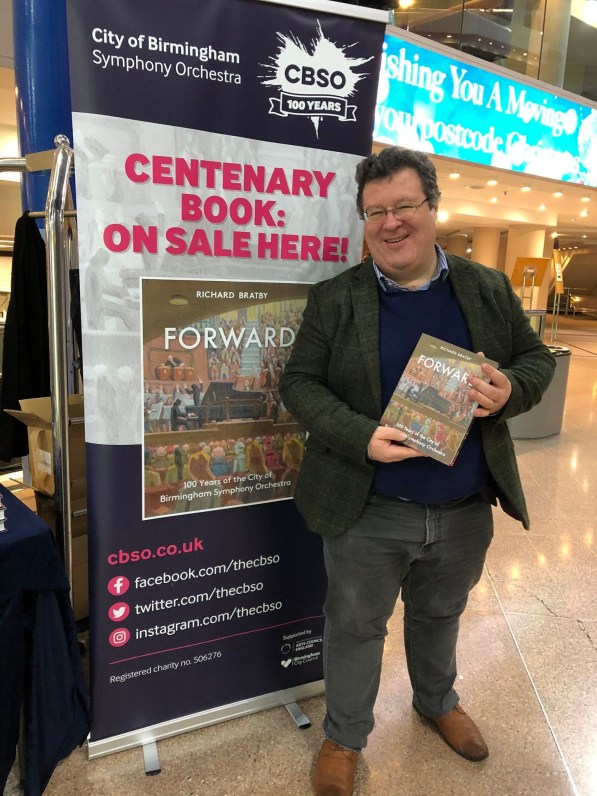
img_20191123_090340

It was very wet in December. That’s my excuse for those shoes.

Life comes at you fast, they say: Forward was published in November and for the next few weeks it seemed like there was hardly a night that I wasn’t at a CBSO concert or at CBSO Centre, signing copies. It was exhausting but huge fun: not just because of the many kind comments about the book itself, but also because it was a chance to meet and chat to the CBSO’s supporters. That was always my favourite part of the job when I was duty manager for concerts at CBSO Centre – the enthusiasm that people feel for “their” orchestra is genuinely touching, and the stories that they have to tell of their concert-going activities are endlessly enjoyable. I spoke to ex-players, ex-singers, and audience members with memories stretching back to the George Weldon era in the late 1940s. Since I always intended the book to be a centenary gift from the orchestra to its friends and followers, this was enormously gratifying.
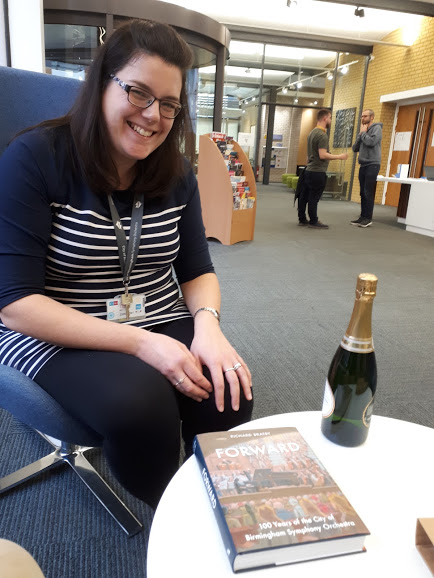
Maria & Forward

My fabulous colleague Maria made the whole thing possible (and discovered most of the best pictures). When the  very first copy of the book arrived at CBSO Centre, the occasion  seemed to call for at least one bottle of fizz.

But it was still something of a surprise to realise that it was actually out there, making its way in the world and being read far beyond Birmingham. I popped into Waterstones on New Street and Foyles in Grand Central to sign copies. “It’s nice to have something in the local history section that isn’t Peaky Blinders” commented the manager. I gave an interval interview about the history of the orchestra on BBC Radio 3, and recorded a series of short films for the CBSO website. The Spectator kindly asked me to write something about the history of the CBSO for its Christmas edition, and BBC Music Magazine followed suit shortly afterwards.

Then there were the reviews, which if I’m honest I dreaded – but since I dish it out regularly as a critic, I was hardly in a position to expect sympathy. In fact, reviewers seem to have been very positive. I was particularly delighted to be reviewed in The Oldie; Richard Osborne wrote that “Such books can be a terrific bore but this is a gem: a lovingly researched, entertainingly written and handsomely designed and printed volume”. Jessica Duchen gave the book one of her end-of-year personal “Awards” on her long-running blog: “gorgeously produced, seamlessly readable, superbly expressed and full of splendiferous anecdotes. A wonderful anniversary tribute to the orchestra, with the lightly-worn engaging touch of the insider who knows exactly how it really works”.

John Quinn, on MusicWeb International, did the book proud: “Richard Bratby has told the story uncommonly well. His style is eminently readable and clear. It’s obvious that the book has been scrupulously researched.” Nigel Simeone, in Gramophone found it “thoroughly engaging” and Norman Lebrecht, in The Spectator (a review of which, like the Gramophone write-up, I knew nothing in advance), noted – with typical acuity – that “no nation state in modern times has chosen great leaders so unerringly well as the CBSO”. BBC Music Magazine gave it five stars.
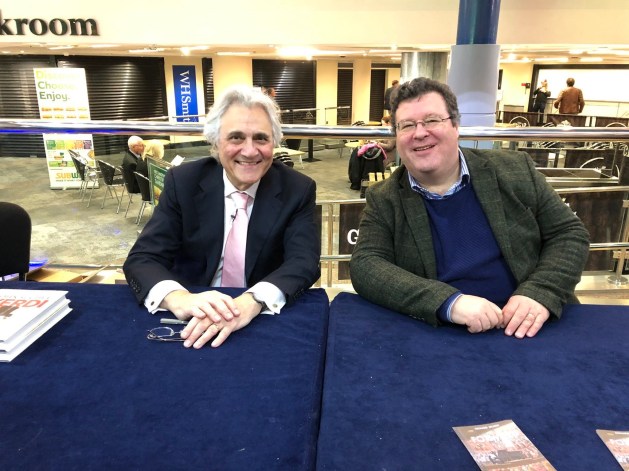
img_20191123_090316

John Suchet was kind enough to endorse the book, so it was a lovely coincidence that we both ended up signing at the same table at Symphony Hall on 22 November. One purchaser wanted John to sign Forward instead of me: and who can blame them?

Since then…well, we all know the story and the fact that the book is currently only available for purchase online is of no significance beside the fact that the CBSO’s long-planned centenary celebrations are on hold and that everyone involved with the orchestra is intensely, anxiously trying to find a way to salvage something. There isn’t much comfort to be had in the current situation, and I’ve never believed that history repeats itself.

But one constant of the CBSO’s history has been the depth of the support that it has received from the community that it serves; that, and a near-miraculous ability for doing great things under intense pressure. The CBSO has turned a crisis into a triumph quite a few times over the last 100 years. Things are worryingly quiet at the moment – though as the orchestra’s CEO Stephen Maddock pointed out a few weeks ago, if you think planning a concert season is hard work, just try cancelling one. But we wait; we hope; we keep the faith. Let’s hope the dawn is not far away.
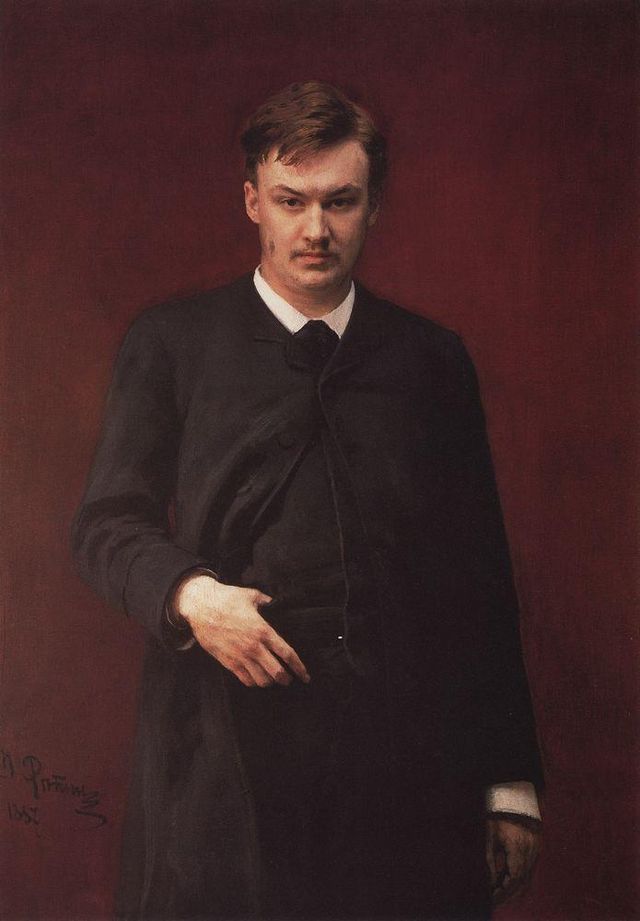
Throwback Monday: Happy 150th birthday, Alexander Glazunov!

10 Monday Aug 2015

Posted by richardbratby in Uncategorized

≈ 3 Comments

Tags

Anniversary, Glazunov, Prokofiev, Shostakovich, Stravinsky

1Glazunov
Yes, Alexander “Sasha” Konstantinovich Glazunov, “Russian Mendelssohn”, child prodigy, favourite pupil of Rimsky-Korsakov, cellist, master symphonist (and rather fine composer for string quartet too), admired teacher of Shostakovich, rather less-admired teacher of Stravinsky and Prokofiev (and unsurprisingly – once you know Glazunov’s music, all sorts of Stravinsky and Prokofiev musical mannerisms seem noticeably less original), inventor of the saxophone quartet (well, pretty much) and legendary vodka drinker, is 150 years old today. Noticed all the anniversary programming, the symphony cycles, the themed night at the Proms? No, me neither.

I’m not going to give you the full range of my thoughts and theories about this special favourite composer of mine right now. (If anyone would like to commission a biography, though…) Instead, to mark the occasion, here’s a programme note I wrote for his wonderful String Quintet Op.39 a few years back. With no word limit, I may perhaps have let my enthusiasm to make Glazunov’s case run away with me: ah well, le coeur a ses raisons…

Opportunities to write about Glazunov don’t come round as often as I’d like: just the Violin Concerto and Saxophone Quartet in recent years. So, if anyone needs anything – anything at all – writing about this incredibly likeable and under-valued composer, you know where to find me! (And I’ll do it for a discount).


“He was a charming boy, with beautiful eyes, who played the piano very clumsily. Elementary theory and solfeggio proved unnecessary for him, as he had a superior ear…after a few lessons in harmony I took him directly into counterpoint, to which he applied himself zealously. Thus his work at counterpoint and composition went on simultaneously…His musical development progressed not by the day, but literally by the hour.”

That’s how Nikolai Rimsky-Korsakov recalled the extraordinary musical phenomenon of the teenage Alexander Glazunov. Balakirev, leader of the so-called “Mighty Handful” of Russian nationalist composers, had already dubbed this bright and engaging son of a St Petersburg publisher “our little Glinka”. By the time Rimsky-Korsakov took his musical education in hand, in 1880, this had turned to talk of a “Russian Mozart”. In March 1882, when Glazunov’s First Symphony was premiered under Balakirev, it caused a sensation. “The audience was astonished” writes Rimsky-Korsakov “when, in response to calls for the composer, a 17 year old boy took the stage in his school uniform.” “This is our Samson!” exclaimed the critic Vladimir Stasov.

Received opinion today has it that Glazunov’s career went pretty much downhill from there. Of course, that’s untrue. Glazunov’s style was yet to peak, and when it did, it combined a sweet and expansive melodic gift with a sparkling sense of orchestral colour. His technical skill was breathtaking. The work we know today as Borodin’s Prince Igor overture was actually written down by Glazunov from memory after Borodin’s death – Glazunov having heard it played through by the composer on the piano. His own eight symphonies have been described as “Rachmaninov on a sunny day”, though the 6th and 8th are works of genuine dramatic power, and the 4th and 5th are gloriously colourful – and could have been written by no-one else. But he was at his most inspired in genres that played to his twin strengths of orchestral colour and long-breathed melody. His Violin Concerto (1904) is still a favourite, and his masterpiece – the one-act ballet The Seasons (1899) – is arguably the greatest ballet score by any composer between The Nutcracker and Petrushka.

And that’s part of the problem – music that charmed and delighted “Silver Age” Imperial Russia looked old-fashioned after 1917. Glazunov was by then Director of the St Petersburg Conservatoire, and although he combined impeccably liberal politics with a courageous and dogged determination to protect his students’ creative freedom, he was an easy target for fashionable radicals, even amongst his own pupils.

The young Prokofiev publicly ridiculed Glazunov (though it’s easy to hear Glazunov’s influence on his own orchestration), and Igor Stravinsky consistently belittled his teacher’s music. It’s not hard to work out why – once you’ve heard The Seasons, Petrushka and Le Sacre de Printemps sound a lot less original. Tellingly, the least socially-privileged of Glazunov’s great pupils, Dmitri Shostakovich, told a rather different story: “a figure of epochal public resonance, a historic figure without exaggeration…blessed for his good deeds by every working musician in the country”. But in 1928 Glazunov, lonely and increasingly isolated, left Russia for France, where he died in 1936.

Glazunov’s reputation has still to receive a truly balanced reassessment – Stravinsky’s venom has blinded two generations of western commentators – but there’s a case to be made for his role as the father of modern Russian chamber music. The teenage Glazunov was an accomplished cellist, and his early patron Mitrofan Belaiev (who founded his own publishing house specially to print Glazunov’s music) hosted regular Friday string quartet soirees. From the earliest years, chamber music was central to Glazunov’s creative life.

Other Russian composers had written quartets and Borodin’s quartet style – lucid, lyrical, and sprinkled with colourful instrumental devices like double stopping, pizzicato and harmonics – was an unmistakable influence on the young Glazunov. But Glazunov was the first Russian composer to write an extended cycle of string quartets, seven in all between 1880 (his Op.1) and 1930, as well as numerous superbly crafted miniatures for string quartet, a brass quartet and a pioneering saxophone quartet (1932). And he wrote as an “insider”, like Haydn, Mendelssohn, and Frank Bridge, with a performer’s instinct for effective and playable string writing. His chamber music may be neglected – but, once you’ve heard it, you can’t miss its influence throughout the quartets of Miaskovsky, Prokofiev (whether he liked it or not) and, supremely, Shostakovich.

His only String Quintet may be the most perfect chamber work he wrote. Dating from 1892, and written for the influential Imperial Russian Music Society in St Petersburg, it’s scored for the same combination as Schubert’s String Quintet – two cellos rather than Mozart’s two violas. To a composer as given to lushness and lyricism as Glazunov, that seems to have been like an open invitation.

Every aspect of Glazunov’s mature style finds expression in this sunlit work. It’s all there: in the first movement, his gift for rhapsodic melody (the opening viola theme) and expansive optimism (the soaring second group). His “musical box” ballet style, in the deliciously scored pizzicato scherzo (possibly a homage to Tchaikovsky’s Fourth Symphony – or any number of Russian nationalist balalaika-imitations from Glinka onwards). His poignant and unfailingly poetic Slav melancholy – turning to real emotion as the Andante sostenuto builds towards its impassioned climax. And his consummate ability to entertain and delight – in a finale that pays its respects to his Russian nationalist roots (that folk-dance first theme), his Conservatoire training (plenty of bustling mock-fugal stage-business) and the great Russian tradition of the big romantic tune, before speeding to an exuberant finish. The Belaiev circle weren’t really the types to dash vodka glasses in the fireplace – but Glazunov’s closing bars certainly suggest a few shot-glasses being cheerfully clinked in friendship.

Contact Details

38 Beacon Street
Lichfield
United Kingdom
Staffordshire
WS13 7AJ

07754 068427

Archives

  • June 2020 (1)
  • October 2019 (2)
  • January 2018 (1)
  • December 2017 (2)
  • November 2017 (2)
  • October 2017 (1)
  • August 2017 (2)
  • July 2017 (1)
  • June 2017 (3)
  • April 2017 (2)
  • March 2017 (2)
  • February 2017 (2)
  • December 2016 (1)
  • September 2016 (3)
  • August 2016 (1)
  • July 2016 (1)
  • June 2016 (2)
  • May 2016 (1)
  • April 2016 (3)
  • March 2016 (6)
  • February 2016 (1)
  • January 2016 (3)
  • December 2015 (6)
  • November 2015 (4)
  • October 2015 (6)
  • September 2015 (5)
  • August 2015 (5)
  • July 2015 (8)
  • June 2015 (12)
  • May 2015 (12)
  • April 2015 (1)
  • February 2015 (1)
  • January 2015 (2)
  • December 2014 (4)
  • November 2014 (3)

Archives

Create a free website or blog at WordPress.com.

Privacy & Cookies: This site uses cookies. By continuing to use this website, you agree to their use.
To find out more, including how to control cookies, see here: Cookie Policy
  • Subscribe Subscribed
    • Richard Bratby
    • Join 29 other subscribers
    • Already have a WordPress.com account? Log in now.
    • Richard Bratby
    • Subscribe Subscribed
    • Sign up
    • Log in
    • Report this content
    • View site in Reader
    • Manage subscriptions
    • Collapse this bar
 

Loading Comments...